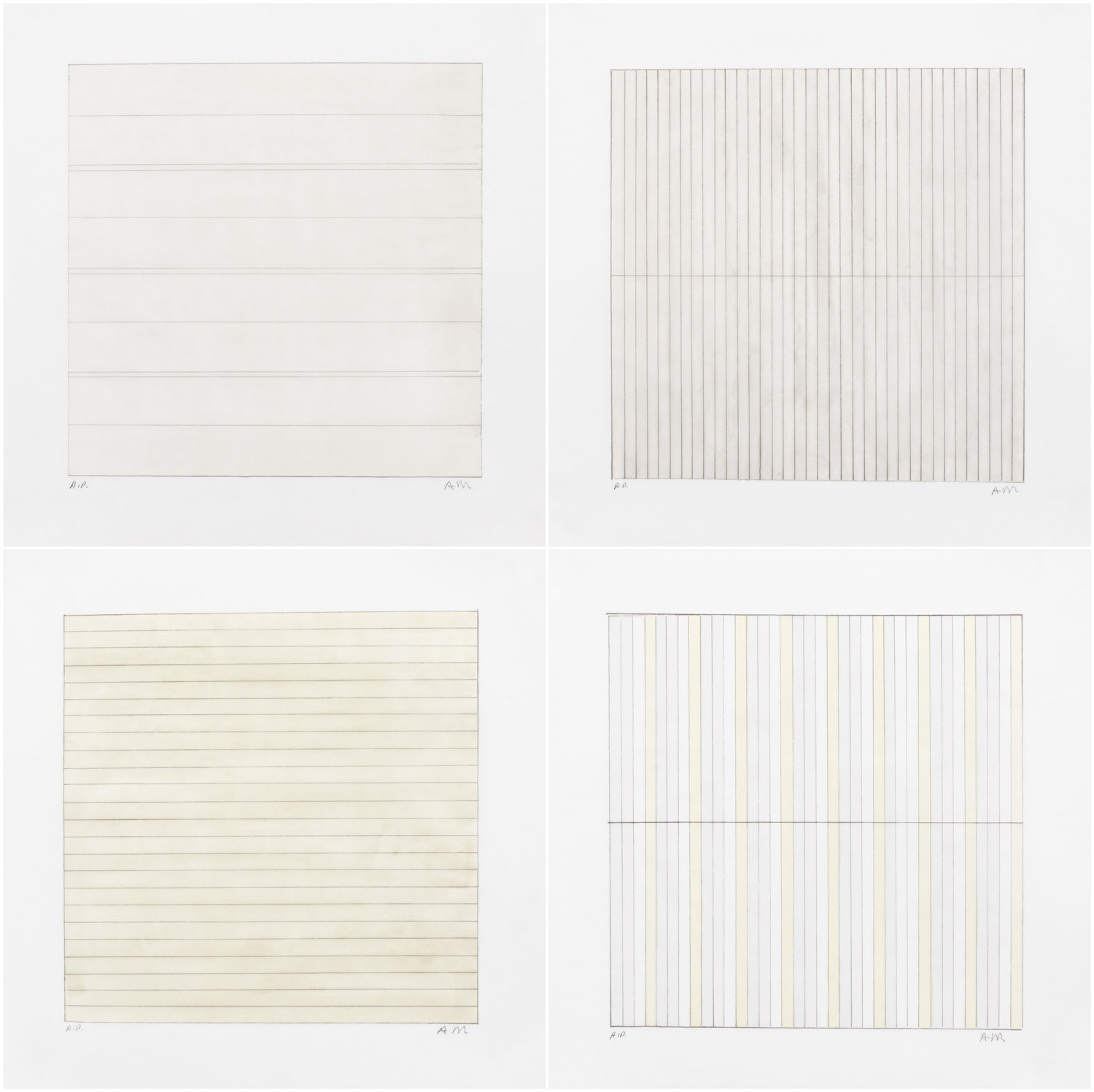
Agnes Martin, born in Saskatchewan, Canada in 1912, immigrated to the United States in 1931. Martin attended the Summer Field School of the University of New Mexico in Taos, New Mexico, in 1942, where she became interested in Buddhist thought and Eastern philosophy, not necessarily as religious practices but as a mode of living life. This practice combined with her growing interested in Abstract Expressionism resulted in Martin being particularly interested in the transcendent potential of painting. Characterized by austere lines and grids superimposed upon grounds of muted color, her paintings elegantly negotiate the confines of structure, space, draftsmanship, and the metaphysical.
Martin’s work has been shown in many various locations, such as the Institute of Contemporary Art at the University of Philadelphia (1973); Hayward Gallery, Southbank Centre, London (1977); Stedelijk Museum, Amsterdam (1991); Whitney Museum of American Art, New York (1993); and Dia:Beacon, Beacon, New York (2004). She has also been honored with the Skowhegan Medal for Painting (1987), Oskar Kokoschka Prize (1992), Golden Lion for Lifetime Achievement at the Venice Biennale (1997), National Medal of Arts from the Office of the President (1998), and Lifetime Achievement Award from the Women’s Caucus for Art (2005). Martin died in Taos, New Mexico, in 2004, among others.